About · the studio
Named for the market that has fed India for three thousand years.
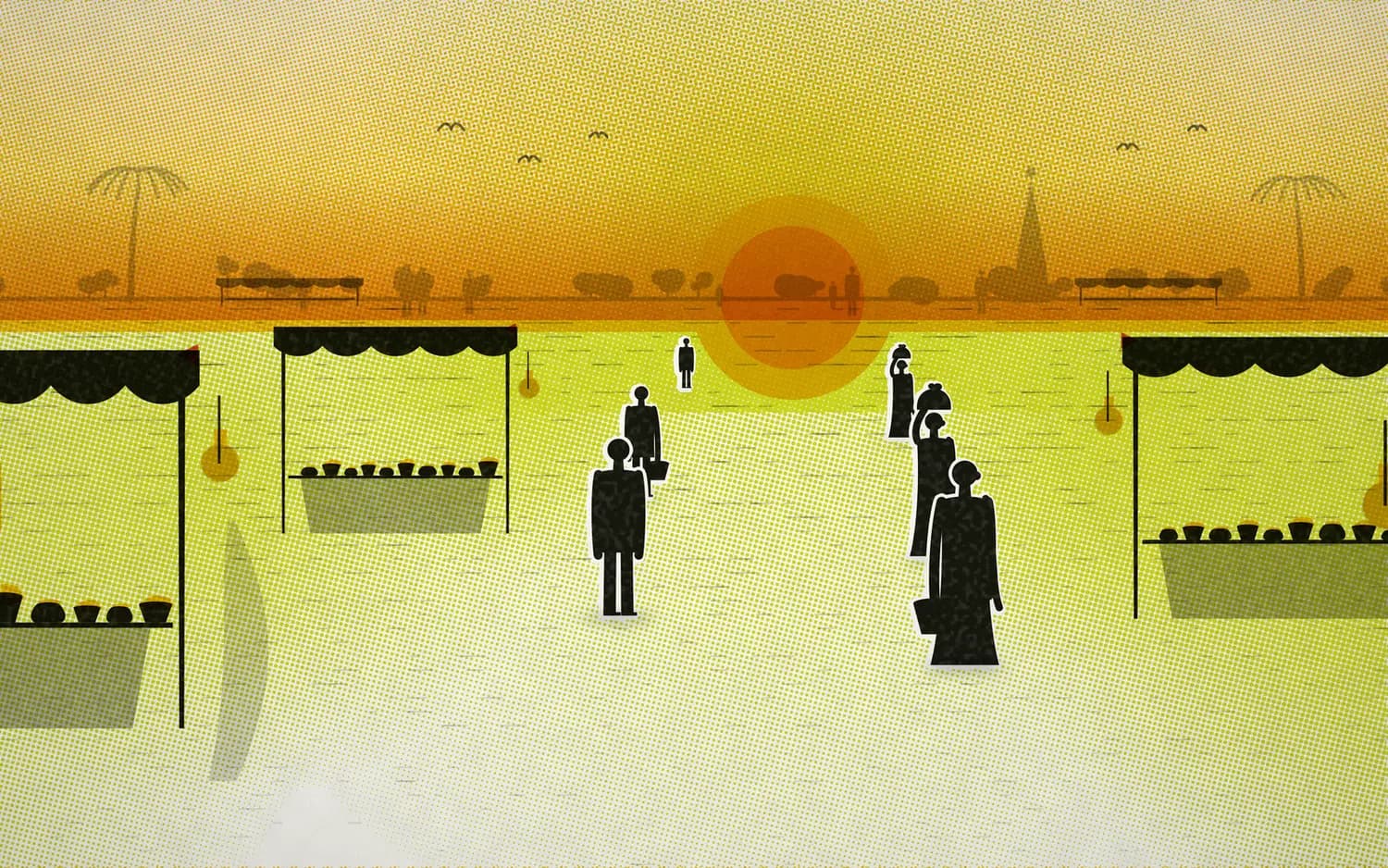
A हाट is the periodic village market — the day the whole countryside comes to buy, sell and settle accounts. It is the oldest software in the subcontinent: a protocol for trust, price and credit that has run without a server since before there were computers. We took its name because we build for the same counter.
The studio, in one line
A software studio in West Bengal, digitising whole businesses — the systems they run on, and everything around them.
Where it began
The hardest shop in India is the best place to start.
We began at a kirana counter in rural Bengal, where the power cuts out mid-bill and nobody at the counter types in English. The queue is six people deep on market day, the man at the front is paying half now and half after harvest, and there is one dusty machine that is nobody’s job to maintain.
Those are not edge cases to us. They are the specification. We built for the power cut, the dead SIM, the credit paid in two halves and the till worked entirely from the keyboard — and found that software which holds up there needs no excuses in a city. So we never built the easy version. We built the hard one, and it already worked everywhere else.
Six counters later — across five trades, three languages, and work that now runs from billing to whole websites — that is still the method: offline-first, keyboard-first, trilingual at parity, on hardware the client already owns. Whatever we’re asked to digitise, we build it the way the counter taught us.
- Where we build
- At the counter, not for it
- Every system starts behind a real till, clinic desk or godown on a busy day — not in a room with a whiteboard.
- What we refuse
- The degraded-downwards app
- We build for the hardest case first. The easy case then comes free; the reverse never does.
- Who we answer to
- The owner, directly
- We deploy and support each build ourselves. No reseller in between, no per-transaction cut.
- 0+
- Businesses live on Haat
- 0
- Languages today, more coming
- 0
- Trades served
- ₹0
- Cost when the line drops
How we build
Six commitments, each named for something already on the counter.
Not a values page written after the fact. These are the rules the six builds were held to, and each one is named in the language of the shop it serves — a taraazu, a bahi, the udhaar book — because a studio rooted in Hindi and Bengali should name its principles there too.
तराज़ू
Taraazu · the balance scale
Every number balances.
Stock, cash and ledger reconcile to the paisa at close of day. If they disagree, the software says so instead of rounding the difference away.
बही
Bahi · the ledger
Nothing is deleted, only corrected.
A bill can be amended, never quietly removed. Every correction keeps the original line beneath it, the way a khata is struck through rather than torn out.
उधार
Udhaar · credit on trust
Trust is a feature, not a workaround.
Half of rural trade runs on credit. Haat tracks it as a first-class ledger with names, limits and reminders — not as a note in the comments field.
भाषा
Bhaasha · language
The shopkeeper's tongue comes first.
Hindi, Bengali and English are built at parity — same screens, same shortcuts, same receipts. Translation is not a settings page we got to later.
बिजली
Bijli · the power line
It works when the line goes down.
Billing runs on the shop's own machine. Power cuts and dead SIMs slow the day; they do not stop it. Sync catches up when the line returns.
हाट
Haat · market day
Built at the speed of the counter.
One hand on the scale, one on the keyboard. Every common action is a keystroke, because a queue of six people is the real performance budget.
If your counter is harder than a spreadsheet, we want to hear about it.
Tell us the trade and what breaks on a bad day. We will tell you honestly whether we are the right studio for it.